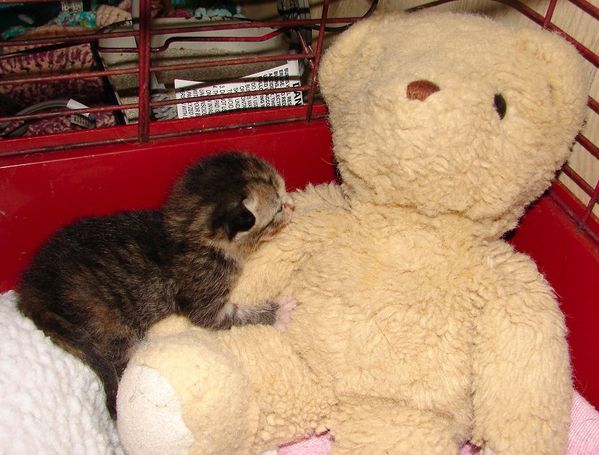
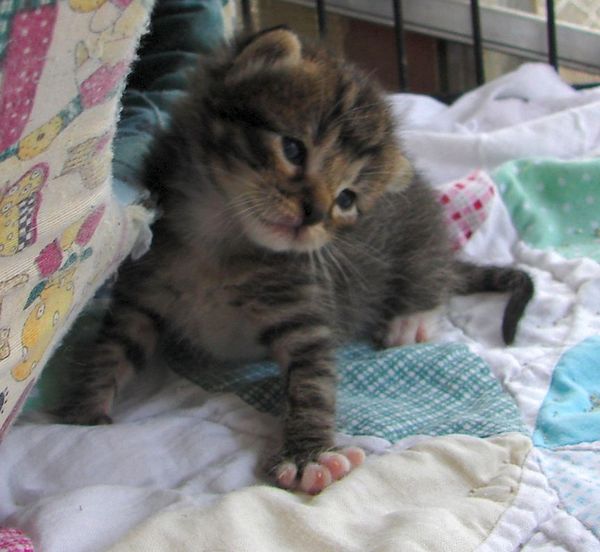
Tractor Tracy's first solid food:
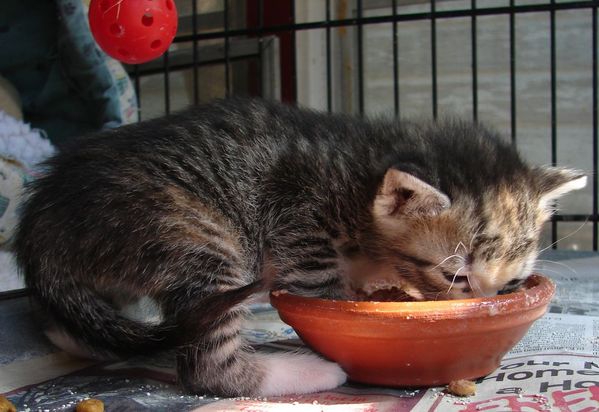
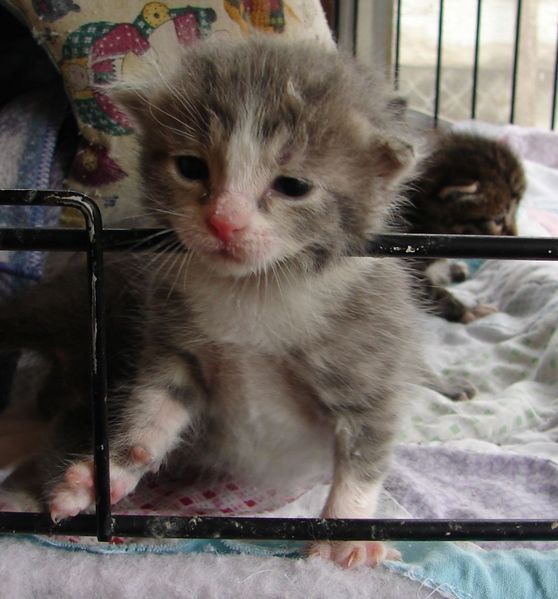
and we have a newcomer, but she won't stay long. Her name is Leonna:
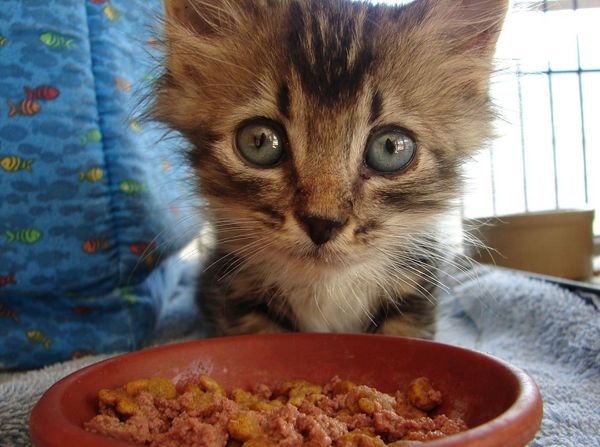
and we have a newcomer, but she won't stay long. Her name is Leonna:

Today my Great Dane had a kitten in his ear :-):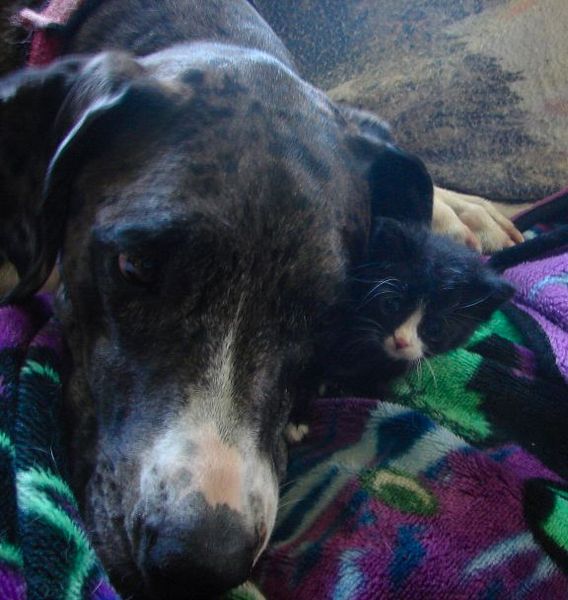
Erica is the only kitten left right now.
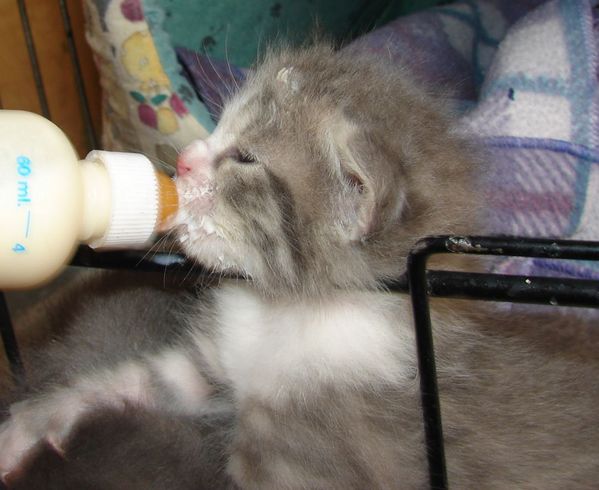
I started cutting down on the milk. They are nibbling on the dry food and are using the litter box now each time they have to go. They still have the small boxes in their cage, but I will exchange it tomorrow for the normal size one. I'm very happy with their progress.
Here they are after feeding:
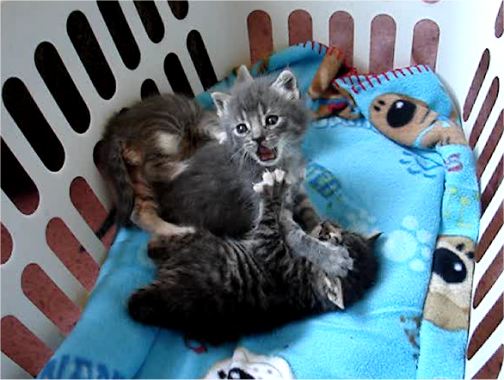
The 4 girls are 1 week old (eyes still closed) and the 3 boys are now 2.5 weeks old. All 7 are doing ok. I received the boys when they were 10 days old and just opening their eyes: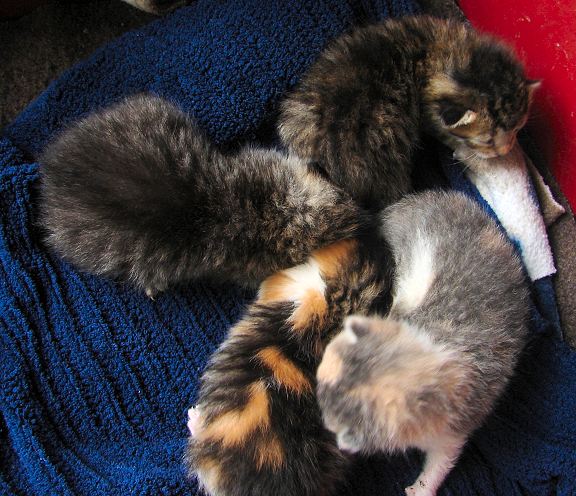
The 3 boys are starting to play now and figuring out balance, hehe: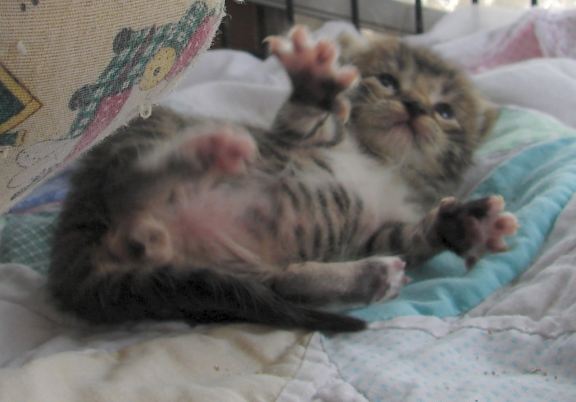
 __________________
The antics of a playful kitten are a delight to watch. This handful of fluff and fun is a fascinating little creature. As you hold it in your hand, consider this: A kitten's tiny body has about 440 bones — nearly 40 more than a human. It has more than 500 separate skeletal muscles compared to some 650 found in the human body.
Look at the ridges on its tiny nose pad. They form a pattern as unique to an individual kitten as a fingerprint is to a human. Behind this nose pad lies a maze of bones and cavities that serve a kitten well. This area, called the mucosa, is nearly twice the size of the olfactory mucosa in humans and indicates the importance of the sense of smell to cats.
A newborn kitten's sense of smell enables it to locate its mother's nipples. Many kittens, shortly after birth, tend to stake out a single nipple which they claim for their own. This acute sense of smell combined with the sense of touch helps guide the newborn until its eyes open at about three weeks and its other senses develop.
The hairless skin of a kitten's nose and its paw pads are particularly sensitive to touch. A kitten learns to use its paws to investigate the texture, size and shape of an unfamiliar object. It may extend a paw, gently touch an object and then touch it firmly before drawing closer to use its nose for a final inspection. Its sense of smell and the tactile paw pads will continue as investigative tools throughout its adulthood.
A newborn kitten relies on its senses of smell and touch because its eyes remain closed for seven to ten days after birth. At first its vision is poor because its retina is not completely developed. It is not able to see as well as an adult for about three months. From then on, its vision becomes one of the most important of its senses.
A kitten's as well as an adult cat's eyes are large compared to the size of its head. If our eyes were as large in comparison to the size of our heads, they would be at least the size of a softball. The large eyes are part of the kitten's heritage, designed to facilitate its work as a hunter.
Throughout its life, a kitten depends upon its whiskers to provide information about its surroundings. Whiskers serve as wind detectors, which, combined with a sense of smell, contribute to its swift identification of the source of any odor. This can be observed as an inquisitive kitten twitches its whiskers as it sniffs.
Whiskers also protect a kitten's and an adult cat's eyes. A springing twig or a sharp blade of grass will touch the whiskers before catching the eye and trigger a protective eye blink. Whiskers fall out periodically to be replaced by new ones.
The loss of whiskers can impair a kitten's or cat's motion and orientation to its surroundings. Sometimes the mother cat will bite off the whiskers of kittens who may wander too far away or are too inquisitive. Mother knows best. Once a kitten is in your custody, never trim or cut off those whiskers.
When a kitten gives you an affectionate lick, you may liken the experience to the feeling of rough sandpaper. This is the result of numerous knobs called papillae on the surface of the kitten's tongue. They form backward-facing hooks which help hold food and provide the abrasion needed for self-grooming.
The taste buds are carried by mushroom-shaped papillae at the tip and sides of the tongue and the cup-shaped papillae at the back of the tongue.
Kittens have their own distinctive eating habits. They tend to consume a large number of small meals. Usually a kitten approaches its food, sniffs it quickly and then starts to eat. After consuming a small portion, a kitten leaves and returns at intervals to eat. This "occasional eating" is typical cat behavior and should not be confused with reluctance or refusal to eat.
As a kitten drinks water, notice how its tongue laps under the water in much the same manner as an elephant uses its trunk. It flicks its tongue quickly in and out of the liquid, swallowing after every third or fourth lap. Because water is involved in virtually every function of a kitten's body, it's important to keep fresh drinking water available at all times in a clean bowl.
While most of us associate catnip with causing a few minutes of extreme playfulness in a kitten, this reaction may not occur. A kitten's capacity to detect and react to catnip is inherited and sometimes described as the presence or absence of a "catnip gene." About 30 percent of cats do not have this gene and will not exhibit any particular behavior in association with catnip. Kittens with the gene usually don't respond to catnip until about six to eight months of age.
A final thought: Perhaps a kitten's most unique trait is its individuality. Each one has its own personality. Properly socializing a new kitten by introducing it with care to its new home, family and friends, will help develop its personality. The result is a delightful companion for years to come.The ASPCA Speaks Out Against Bonsai Kitten Website
Encourages shutdown of offensive Web site.
FOR IMMEDIATE RELEASE
(NEW YORK) UPDATED January 17, 2005 -- The Bonsai Kitten Web site has generated a lot of feedback from concerned individuals in the animal welfare community. The ASPCA shares your anger and concern about Bonsai Kitten. While the Internet has made a positive contribution to our society, it has also resulted in the rapid expansion of publicity for individuals who promote animal abuse. The ASPCA as well as other major humane organizations across the U.S. have attempted to discourage the promoters of this Web site from their activity.
Our Humane Law Enforcement Department, as well as other law enforcement agencies, is aware of the Bonsai Kitten site and has determined that it is a hoax site operated by an MIT student in Massachusetts, (not in New York, as had been stated on the Web site). Moreover, thanks to the active participation of Web-users such as yourselves, the Web site has been forced to shut down and move a number of times before finding its present host.
In the United States, individuals have the constitutional right to freedom of speech; therefore, they may discuss and advocate for animal abuse on the Internet and in other public forums as long as they don't practice what they preach. As such, the matter becomes the responsibility of the particular Internet service providers ("ISPs"). Unfortunately, Bonsai Kitten's new service provider, www.rotten.com, refuses to remove the site on freedom of speech grounds. Since contacting the Web site directly has only increased the creators' resolve to maintain the site, and the new host is unwilling to remove it, we recommend that concerned citizens NOT contact the person running this site or any other Bonsai Kitten related sites. These are obviously individuals who are just looking for attention. The best thing that we can do is ignore the Web site creators and complain to the host Web site's advertisers.
We appreciate your effort in contacting us, and would like to give you some general information on how to fight against this and any other similar sites that you may encounter. Unfortunately, new ones appear every day.
A 1999 federal law bans the knowing creation, sale or possession of depictions of animal cruelty, with the intention of placing the depiction into interstate or foreign commerce for commercial gain. The new law covers any visual or auditory depiction of intentionally maiming, mutilating, torturing, wounding or killing a live animal. If the conduct in the depiction is illegal under federal law, or state law in the state where the creation, sale or possession takes place, then this new law will apply. The place where the actual animal cruelty took place is not significant under this statute. Anyone convicted of the interstate or foreign sale of these depictions of animal cruelty can be faced with a fine, or up to a five year prison sentence. An exception is made for depictions serious with religious, political, scientific, educational, journalistic, historical or artistic value.
If you have concrete information that an individual is engaged in the creation, sale or possession (with intent to sell) of these depictions of cruelty, and you know which city this person lives in, the most effective response is utilizing traditional measures. While the ASPCA is a national organization in many respects, our powers to enforce animal cruelty laws are limited by law to the State of New York; however, we are concerned with addressing acts of animal cruelty and neglect wherever they occur. In situations where acts of animal cruelty occur outside the State of New York, we would urge you to contact any or all of the following organizations and advise them of the situation:
1) your local society for the prevention of cruelty to animals (SPCA) and/or humane society (which may have the power to enforce animal cruelty laws in the area);
2) your local law enforcement officials;
3) your local city/county health department (because abuse of animals often involves unsafe or unsanitary conditions for humans);
4) your federal, state and local taxing authorities (because operations involving cruelty to animals often operate without filing or paying taxes);
5) The Internet Fraud Complaint Center at http://www.ifccfbi.gov/, a joint partnership between the FBI and The National White Collar Crime Center established to address fraud committed over the Internet;
6) local and national media organizations;
7) http://www.h4ha.org/stopcruelty/index.html, a group that is attempting to stop sites advocating cruelty to animals; 8) any ISP hosting a Web site advocating animal abuse. You can find the address of an ISP by connecting Network Solutions at http://www.networksolutions.com/ and inputting the name of the Web site. (NOTE: Network Solutions merely registers domain names and is not responsible in any way for the content of the Web sites it registers); and9) the ISP that you regularly do business with, to encourage them to screen their own sites and not allow Web sites promoting animal cruelty.
Note: "Local", as used above, means based in the area from which the Web site originates.